
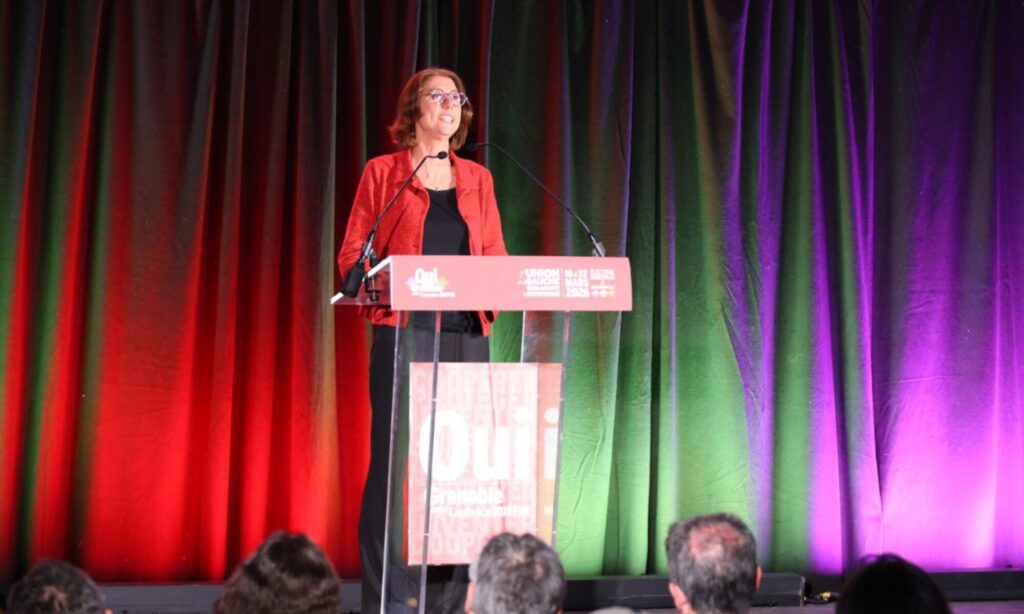
Four days before the second round of the municipal elections, the « Oui Grenoble » list held its grand rally at the Palais des Sports. Several hundred Grenoble residents answered the call, filling the hall with an energy at once joyful and resolute. The goal was clear: to rally in force behind Laurence Ruffin’s candidacy and make history for the city. To carry that message, the evening brought together national elected officials, mayors from the metropolitan area, and prominent figures of municipalism — among them François Ruffin, Guillaume Gontard, Cyrielle Chatelain, and Philippe Rio, mayor of Grigny. Together, they wove the narrative of a rebel and pioneering city that has a date with a new chapter of its history this Sunday.
Photo Guillaume Laget DR
This Sunday, 22 March, Grenoble could write a new page of its history: the election of Laurence Ruffin, who would become the city’s first ever women mayor. The conditions for it to happen are in place: in the first round, the combined left-wing lists reached 58% of votes cast against the right-wing lists — a balance of power that confirms Grenoble remains, at its heart, a city of the left. Admittedly, Alain Carignon came first in the first round, with a narrow lead over Laurence Ruffin — but that lead does not reflect the true balance of power between the two camps. Because behind her stands the entire united left, pushing forward. The full mobilisation of all left-wing and green forces for the second round will therefore be decisive — and that is the whole challenge of these final days of campaigning.
Behind Laurence Ruffin stands a coalition of fourteen left-wing parties — including La France Insoumise — united « in the spirit of the Nouveau Front Populaire. » It is one of the broadest coalitions the city has seen in a municipal election. And yet nothing is decided: for on the other side, Alain Carignon represents everything this city has historically known to reject. Yesterday, it was corruption and privatisation, when he handed Grenoble’s water supply to the Lyonnaise des Eaux in a system of personal enrichment condemned by the courts. Today, it is a reactionary, climate-sceptic and authoritarian vision that contradicts the very soul of this city, honoured as a Companion of the Liberation. Between the two candidates, it is not merely one municipal programme set against another — it is a certain idea of Grenoble that is at stake.
In an atmosphere that was convivial yet tinged with a particular gravity — the kind that characterises great moments, when you sense that something important is unfolding — what struck the audience at the Palais des Sports that evening was the coherence of the narrative that emerged from the speakers’ addresses. As the evening progressed, something was being constructed — as though distinct stones, laid one after another, were ultimately forming a single edifice. A collective story: that of a rebellious, pioneering city that has never ceased to be ahead of its time. But a story that does not look backwards — one that takes the measure of this long history to ask what Grenoble has yet to accomplish, and what this Sunday might finally make possible. For Sunday, Grenoble has a date with its own history.
The first speaker of the evening was from Grenoble Alpes Collectif. Before the national figures, before the senators and members of parliament, it was the voice of citizens that spoke first. The voice of a collective that upholds a demanding conception of municipalism: not the top-down management of a city, but the democratic transformation of a territory by and with its inhabitants. This opening address set the tone for the entire evening. If Grenoble has a date with History this Sunday, it is because women and men, organised and rooted in their neighbourhoods and communities, have decided to take their destiny into their own hands. In Grenoble, municipalism is not a slogan — it is a practice, a method, a commitment. And it is from that commitment that the « Oui Grenoble » coalition is expected to govern.
It was precisely that commitment that Philippe Rio, the PCF mayor of Grigny (Essonne), came to embody. Recognised for his work against poverty and just re-elected in the first round with 65.78% of the vote at the head of a left-wing unity list, his presence in Grenoble was not merely a gesture of political solidarity — it was living proof that this demanding form of municipalism, rooted in social realities, delivers results. For Philippe Rio said it with a clarity that resonated throughout the hall: the challenge on Sunday does not end with winning. Victory is essential — but the real test lies in governing the city. And on that front, Grenoble has a history that speaks for itself. From the earliest municipalisation of public services to the experiments of Dubedout and Éric Piolle, Grenoble has always known how to demonstrate that the left concretely transforms the daily lives of its residents. An unbroken tradition — with one notable exception: the Carignon interlude, that era of corruption and privatisation. An interlude that Grenoble managed to close — and must not reopen on Sunday.
Philippe Rio also came to deliver a message on city diplomacy. In a world where nation-states are retreating in the face of climate crises and conflicts, it is municipalities that forge connections, cooperate and resist. As co-president of the UCLG Commission on Social Inclusion, Participatory Democracy and Human Rights — the global network of cities working to ensure that local voices are heard in major international decisions — Philippe Rio embodies this deep conviction: local authorities are places of resistance and resilience where human rights are defended and won every day. Cities are not merely spaces to be managed — they are fully-fledged political actors, capable of building a different kind of globalisation, from below, through peoples, through territories. He recalled in this respect the concrete partnerships built between Grenoble and its twin cities, notably with Bethlehem in Palestine — with whom Grenoble maintains an active bond of solidarity, refusing to allow friendship between peoples to be subordinated to the logic of war. A diplomacy of proximity, resistance and emancipation — in the very image of what Grenoble has always stood for.
Philippe Rio also paid tribute to another pillar of this city: public services, and all the associations that work every day for solidarity, sport and culture. The thousands of volunteers, activists and educators who sustain social cohesion in the city’s neighbourhoods. These vital forces that the right, wherever it governs, systematically works to weaken — by cutting subsidies, undermining organisations, and leaving individuals to fend for themselves. For this, too, is what is at stake on Sunday: defending associations means defending a certain idea of the city — one where no one is left behind. That, too, is a page of Grenoble’s history that Sunday must protect.
Guillaume Gontard, Senator for Isère and president of the Écologistes — Solidarité et Territoires group in the Senate, grounded his address in a conviction that runs through all his political work. He stressed the importance of the bond between the capital of the Alps and the surrounding municipalities — a bond of cooperation, solidarity and shared planning. That bond was not an abstract idea that evening: it was embodied in the room itself. The mayor of Échirolles and the newly elected mayor of Saint-Martin-d’Hères were present alongside Laurence Ruffin, signalling that the momentum extends well beyond the boundaries of the central city. The city of all revolutions can only write its next chapter by carrying its entire territory with it. That is the fabric that Laurence Ruffin will need to weave and strengthen — making Grenoble not a solitary beacon, but the beating heart of an urban region moving forward together.
It was François Ruffin, member of parliament for the Somme and founder of the Debout! movement, who gave the evening a national dimension. Brother of the candidate and already present at the first-round rally, he spoke at length about Grenoble’s progressive tradition in all its depth. The Journée des Tuiles of 1788 — not only a prelude to the French Revolution, but also a popular revolt against the privatisation of forests and water rights. The first mutual aid societies, from 1803. The first three women’s mutual societies in France, in 1822. The municipalisation of water, gas and electricity from 1903. The title of Companion of the Liberation in 1944. The first family planning clinic in France in 1961. The Dubedout experiment and the laboratory of municipal socialism. But François Ruffin did not content himself with laying out this prestigious inventory. He turned it back towards the present, with a simple and decisive question: could this city — the city of the Tuiles, the Resistance fighters, the mutualists and the militants — choose Carignon on Sunday? The hall answered: NO. Grenoble does not vote for a mayor who is a symbol of corruption. Not this Grenoble. And that is why he called on every Grenoble resident to mobilise on Sunday.
Cyrielle Chatelain, member of parliament for the second constituency of Isère and president of the Green group in the National Assembly, placed the forthcoming mandate in a broader perspective. She recalled the concrete advances of the decade of ecological governance now drawing to a close, paying tribute to Éric Piolle, who was met with applause. Tangible, real achievements that have transformed the face of the city. But Cyrielle Chatelain refused to rest on that record. For while Grenoble has moved forward, social and environmental inequalities have not disappeared. Grenoble’s ecology is not a legacy to be defended: it is a momentum to be amplified, a project to be deepened, a promise to be kept with every resident of the city. And that promise, on Sunday, begins to be written.
It was Laurence Ruffin who closed the evening, giving this shared narrative a decisive impetus that drew a deep and attentive silence from the audience. Standing in contrast to Alain Carignon, she forcefully defended the image of a city that remembers what it is: « the Grenoble we love — the rebellious, solidary, emancipatory, anti-racist city, open to the world. » But Laurence Ruffin did not come simply to celebrate a history — she came to demonstrate that she is ready to write what comes next. From the very day after the election, she declared with a clarity that cut across the room, she will be ready to govern. Ready to face the challenges awaiting the city: housing, the ecological transition, public services, working-class neighbourhoods, the metropolitan area. Ready to honour the promise of a municipalism that governs with its residents, not above them. For if Grenoble’s history is a great one, what matters on Sunday is what we do with it — and Laurence Ruffin showed that evening that she knows exactly what she intends to make of it.
The contrast with her opponent was embraced to the very end. On one side, a candidate who stands for what Grenoble is and for what it can become. On the other, a candidate who betrayed it — yesterday through corruption and privatisation, today through a reactionary, climate-sceptic vision that contradicts the very soul of this city, honoured as a Companion of the Liberation. If the evening celebrated Grenoble’s history, it also, between the lines, sketched the contours of a historic challenge. For the experience of recent decades has brought to light a fundamental tension that Laurence Ruffin will need to resolve. Neoliberal policies have profoundly weakened social ties, generating a distrust of institutions — as evidenced by the rise of the far right across France, but also by the fact that some voters in Grenoble’s working-class neighbourhoods are tempted by Carignon, feeling that they have not been heard. That distrust is real. It cannot be dispelled by speeches — it can only be overcome through action.
The municipal ecology has produced tangible achievements. But it has not always managed to overturn the power dynamics that keep residents of working-class neighbourhoods at a remove from the places where decisions about their futures are made. Ecology has too often been made for the people — and not enough by them. That is precisely the challenge that Laurence Ruffin and her vision of cooperative municipalism are called upon to meet. Grenoble has every asset it needs to rise to it: a long tradition of popular education inherited from Peuple et Culture, solid public services, a dense network of neighbourhood associations, and a history that has demonstrated that residents of working-class areas, when given the means to do so, are capable of contributing to the city’s story and becoming its agents. The stakes are clear: to rebuild solidarity and construct a popular ecology in which neighbourhood residents — on the front line of environmental injustice — become those who decide on the transformation of their own territory. An ecology that defends public services, extends free access, builds urban commons, and makes every school, every library, every public utility a realisation pointing towards shared abundance, beauty and wellbeing for all. And one that is embedded, as Philippe Rio reminded us, in a form of city diplomacy oriented towards international solidarity.
For what is at stake this Sunday in Grenoble goes beyond Grenoble. In a France where the far right is on the rise, every municipal victory matters. Every city is proof that unity is possible, that an alternative project is desirable, that the French people can choose something other than resignation or the far right. Grenoble — a city of Resistance from time immemorial — could once again become what it has so often been: a signal of what is possible, the spark of a national momentum. The city that, in 1788, foreshadowed the French Revolution could help ignite a new dynamic for a popular, ecological left capable of governing.
By the evening’s end, the message was clear. To vote for Ruffin on Sunday is to continue the gesture of those who, since 1788, have made Grenoble a city ahead of its time. It is not simply choosing a mayor — it is choosing to invent a form of municipalism that transforms the city alongside its residents, cooperates with its territory, and looks upon the world with solidarity. Grenoble has always known how, in decisive moments, to prove itself worthy of its history.
Sunday 22 March is the appointment. And between now and then: full mobilisation — to give everything we have in the fight for Grenoble.
David Gabriel — 19 March 2026
